Reticulocytes
200 UAH
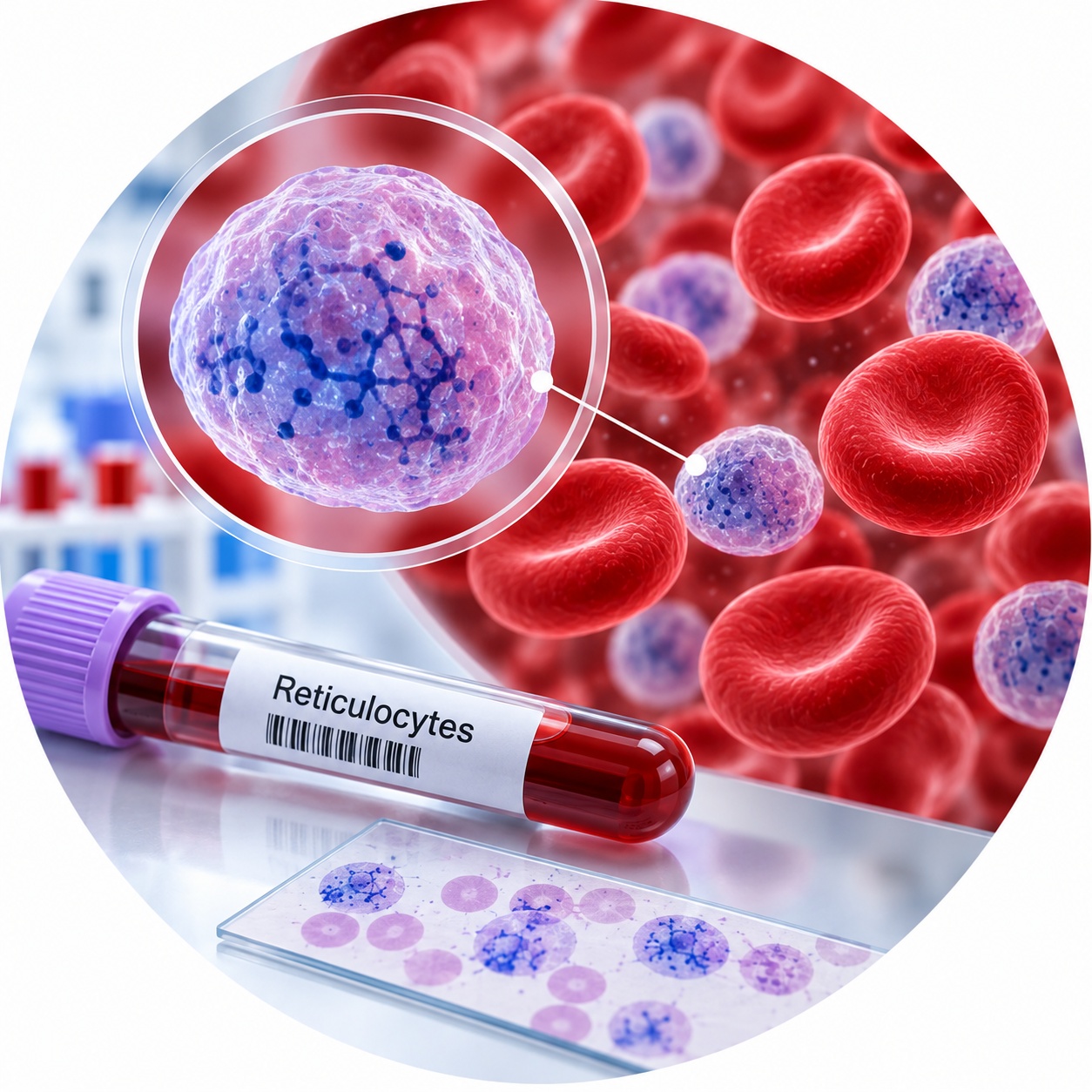
Reticulocytes — a laboratory test that determines the number of young forms of red blood cells in the blood. The test helps assess the activity of hematopoiesis in the bone marrow and its ability to form new red blood cells, in particular during the diagnosis and control of anemia.
Reticulocytes — young forms of erythrocytes, the number and characteristics of which can be used to assess the activity of new erythrocyte formation in the bone marrow. The study is especially important in assessing anemia, blood loss, and the effectiveness of treatment.
Research indicators
Depending on the technique and hematology analyzer, the following can be determined:
| Indicator | What does it mean? |
|---|---|
| RET% | Percentage of reticulocytes among erythrocytes |
| RET# | Absolute reticulocyte count |
| IRF | Proportion of immature reticulocytes |
| LFR | Reticulocyte fraction with low residual material |
| MFR | Proportion of reticulocytes with an average degree of immaturity |
| HFR | Proportion of the most immature reticulocytes |
| RET-He/CHr | Hemoglobin content in reticulocytes |
| MRV | Average reticulocyte count |
| RPI | Adjusted reticulocyte index for assessing bone marrow response in anemia |
Not all indicators are necessarily included in each form — the list depends on the equipment and research methodology.
What can be assessed by the results?
RET% and RET# show how many young red blood cells are circulating in the blood. An increase may indicate increased erythropoiesis, for example after blood loss or increased destruction of red blood cells.
IRF, LFR, MFR and HFR characterize the degree of maturity of reticulocytes. An increase in the proportion of immature forms may reflect the activation of bone marrow function.
RET-He/CHr characterizes the amount of hemoglobin in young erythrocytes and can be used to assess the iron supply of erythropoiesis.
RPI helps assess how adequate the bone marrow response to anemia is.
Reticulocytes in anemia
The indicator has the greatest diagnostic value together with the results of a complete blood count.
| Combination of indicators | What is being assessed? |
|---|---|
| Hb ↓ + RET ↑ | Does the bone marrow respond to anemia by increasing the production of red blood cells? |
| Hb ↓ + RET ↓ | Possible insufficient formation of new red blood cells |
| RET% ↑ | Activation of erythropoiesis |
| RET% ↓ | Reduced production of young red blood cells |
| IRF ↑ | Increased proportion of immature reticulocytes |
| RET-He ↓ | May indicate insufficient availability of iron for hemoglobin formation |
Reticulocytes and other tests
For a complete assessment, the doctor can compare the result with:
- RBC — the number of erythrocytes;
- Hb — hemoglobin;
- Hct — hematocrit;
- MCV — average volume of erythrocytes;
- MCH and MCHC — indicators of erythrocyte saturation with hemoglobin;
- RDW — distribution of erythrocytes by size;
- ferritin;
- iron;
- transferrin;
- vitamin B12;
- folic acid.
When is it prescribed?
A reticulocyte count test may be recommended:
- with anemia of unknown origin;
- after blood loss;
- if hemolysis is suspected;
- to monitor anemia treatment;
- to assess the recovery of hematopoiesis;
- together with ZAK when changing the indicators of the erythrocyte line.
Approximate values
In adults, the reticulocyte count is often around 0.5–2.5%, but reference ranges depend on the technique, age, gender, and specific analyzer.
Therefore, when obtaining the result, it is necessary to focus on reference interval specified in the Medi Lab Plus form.
Preparation for analysis
No special preparation is usually required for the reticulocyte count. If other tests are being performed at the same time, the general recommendations for the entire suite of tests should be followed.
To monitor the dynamics of the indicators, it is advisable to repeat the analysis under the same conditions.
Interesting fact
Reticulocytes are a kind of «"bone marrow function indicator"». A change in their number can show whether the formation of new red blood cells has been activated, even when assessing hemoglobin alone is not enough.
Importantly: The reticulocyte count result does not establish a diagnosis on its own. It is evaluated together with a complete blood count, iron metabolism indicators, and other laboratory data.
| Execution time | 1 day |
|---|---|
| Type of biomaterial | Blood with EDTA |