“Healthy Hair” - a comprehensive laboratory study
Original price was: 5,070 грн.4,560 UAHCurrent price is: 4,560 грн.
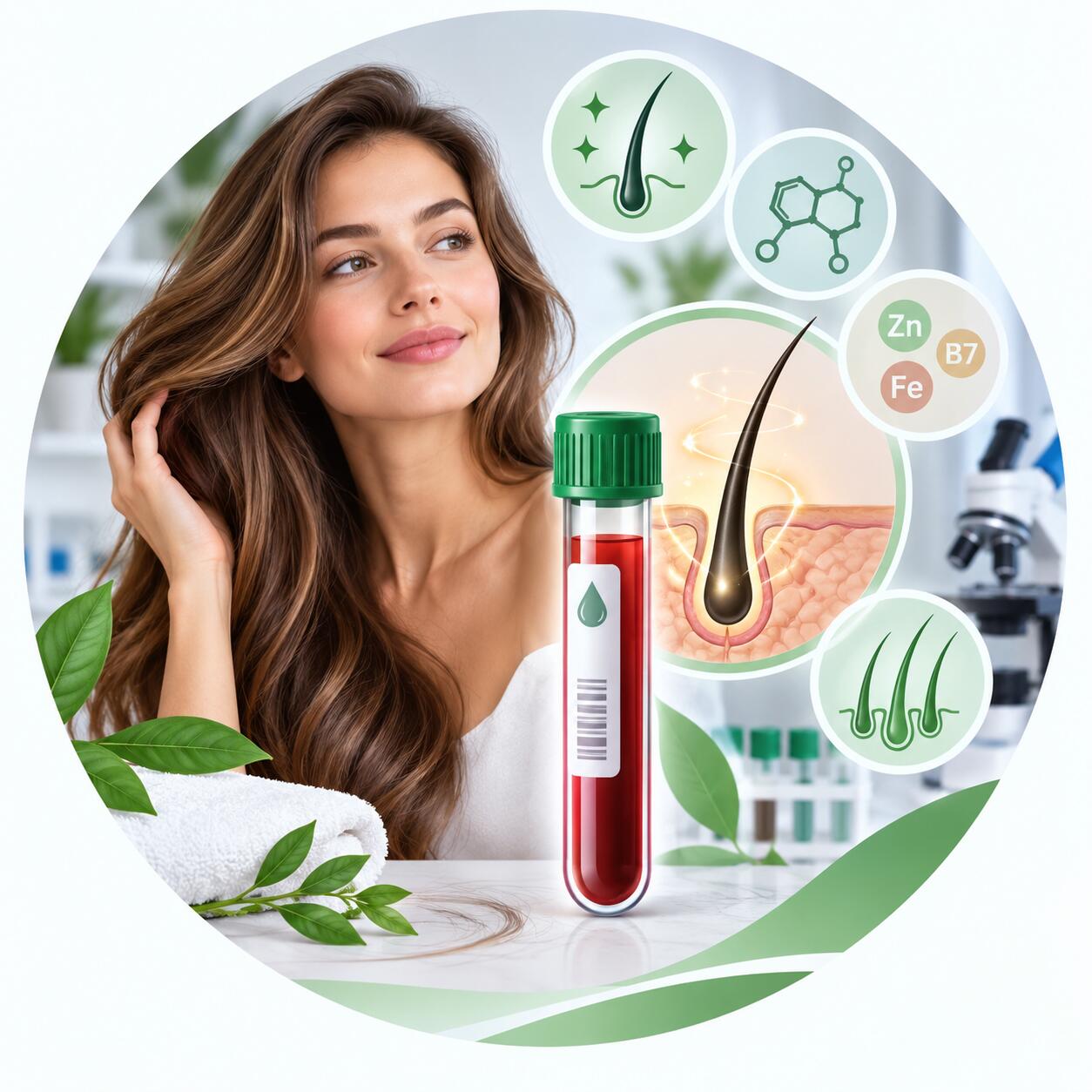
Comprehensive laboratory study "Healthy Hair" to assess indicators related to the condition of hair, thyroid gland, iron metabolism, vitamins and trace elements. The complex includes TSH, FT4, FT3, ferritin, iron, zinc, copper, magnesium, vitamins B9, B12 and D, testosterone, estradiol and other indicators.
Comprehensive Hair Health Study includes 17 laboratory parameters, which allow you to assess the functioning of the thyroid gland, the level of sex hormones, iron reserves, and the body's supply of vitamins and microelements.
The complex includes:
- thyroid-stimulating hormone (TSH);
- free thyroxine (FT4);
- free triiodothyronine (FT3);
- antibodies to thyroglobulin (ATTG);
- antibodies to thyroid peroxidase (TPO);
- total testosterone;
- estradiol;
- total protein;
- copper (Cu);
- ferritin;
- iron (Fe);
- potassium (K⁺);
- magnesium (Mg);
- zinc (Zn);
- vitamin B9 (folic acid);
- vitamin B12 (cyanocobalamin);
- Vitamin D — 25-OH Vitamin D Total (D2+D3).
TSH, FT4 and FT3 - assessment of thyroid function
Thyroid stimulating hormone (TSH) regulates thyroid function. Together with free thyroxine (FT4) and free triiodothyronine (FT3) it allows you to assess the functional state of the thyroid gland.
Thyroid dysfunction can be accompanied by changes in the structure and growth cycle of hair. Therefore, in case of diffuse hair loss, changes in its structure or slowing down of growth, the doctor may prescribe a test for TSH, FT4 and FT3.
FT4 (free thyroxine) — the biologically available fraction of thyroxine circulating in the blood. The indicator is assessed together with TSH and, if necessary, FT3.
FT3 (free triiodothyronine) — the free fraction of triiodothyronine, one of the main hormones of the thyroid gland.
The most comprehensive assessment TSH + FT4 + FT3, rather than one indicator separately, allows you to get more information about the function of the thyroid gland.
ATTH and ATTP — antibodies to thyroid components
The complex includes two indicators related to autoimmune processes:
Anti-thyroglobulin antibodies (ATG) — antibodies to thyroglobulin, a protein involved in the synthesis of thyroid hormones.
Anti-thyroid peroxidase antibodies (ATPO) — antibodies to the enzyme thyroperoxidase, which is involved in the synthesis of thyroid hormones.
ATTH and ATTP are not used alone to determine the cause of hair loss. Their results are evaluated together with TSH, FT4, FT3, symptoms, and other data.
Ferritin and iron — assessment of iron metabolism indicators
Ferritin reflects iron stores in the body. That is why this indicator is often examined when there are complaints of hair loss, especially if there are also signs of possible iron deficiency.
Iron (Fe) shows the concentration of iron in the blood at the time of the study. It should not be interpreted separately from ferritin and other indicators of iron metabolism.
Combination ferritin and iron provides more information than evaluating just one of these indicators.
If abnormalities are detected, the doctor may additionally prescribe complete blood count, transferrin, transferrin iron saturation, or other studies depending on the clinical situation.
Testosterone and estradiol are sex hormones
Total testosterone (Testosterone) — the main androgenic hormone found in both men and women. The indicator is important in assessing hormonal status.
Estradiol — the main representative of estrogens of reproductive age. Its concentration depends, in particular, on gender, age, and physiological state.
Testosterone and estradiol results should be evaluated taking into account gender, age, in women - day of menstrual cycle, taking hormonal drugs and clinical symptoms.
To assess the causes of hair loss, these two indicators should not be considered in isolation.
Zinc, copper and magnesium
The complex includes three important trace elements.
Zinc (Zn) participates in the work of numerous enzyme systems, protein synthesis and cell division processes. Hair consists mainly of keratin, a protein, the synthesis of which also depends on the normal provision of the body with necessary nutrients.
Copper (Cu) It is necessary for the functioning of enzymes and a number of metabolic processes. It is also involved in the formation of connective tissue and iron metabolism.
Magnesium (Mg) participates in a large number of biochemical reactions, energy metabolism, and the functioning of the neuromuscular system.
Important: The concentration of a trace element in the blood does not always fully reflect its total reserves in the body, so the results should be evaluated together with nutrition, symptoms, concomitant conditions, and other laboratory indicators.
Vitamins B9 and B12
Vitamin B9 (folic acid) necessary for DNA synthesis, cell division, and normal hematopoiesis.
Vitamin B12 (cyanocobalamin) participates in hematopoiesis, DNA synthesis, and nervous system functioning.
Since hair follicle cells are actively dividing, adequate nutrient intake is essential for normal body function. However, B9 and B12 results should not be evaluated in isolation, but in the context of overall health and other indicators.
Vitamin D — 25-OH Vitamin D Total (D2+D3)
The complex includes research 25-OH Vitamin D Total (D2+D3) — determination of the total level of 25-hydroxyvitamin D, which is the main laboratory indicator for assessing the body's vitamin D supply.
Vitamin D is involved in the regulation of calcium and phosphorus metabolism, bone tissue function, and immune system function.
The test result allows you to determine the level of 25-OH vitamin D and assess its compliance with the reference range specified by the laboratory.
Total protein
Total protein (Protein total) — total concentration of major proteins in blood serum.
Proteins are necessary for building and repairing tissues, transporting various substances, and ensuring many physiological processes.
Hair is composed mainly of keratin, a structural protein. At the same time, the total protein index itself is not a specific test for assessing hair growth or loss. Its inclusion in the complex provides additional information about the protein status of the body.
Potassium
Potassium (K⁺) — the main intracellular electrolyte that participates in maintaining water and electrolyte balance, transmission of nerve impulses, and muscle function.
Potassium is not a specific marker of hair condition. Its determination in a complex provides additional information about the body's electrolyte balance.
What can be assessed based on the results of the complex
The Hair Health Complex allows you to simultaneously obtain laboratory data in several areas:
| Direction | Indicators |
|---|---|
| Thyroid gland | TSH, FT4, FT3, ATTG, ATTPO |
| Sex hormones | Total testosterone, estradiol |
| Iron metabolism | Ferritin, iron |
| Micronutrients | Zinc, copper, magnesium, potassium |
| Vitamins | B9, B12, 25-OH Vitamin D |
| Protein metabolism | Total protein |
This set allows you not to reduce the assessment of hair condition to just one indicator. For example, in case of hair loss, you can simultaneously assess: ferritin, iron, TSH, FT4, FT3, vitamin D, B12, B9, zinc and other complex indicators.
How to correctly evaluate results
The result of each analysis must be compared with reference values given specifically on your laboratory form. For hormones and some other indicators, values may depend on age, gender, physiological state, medication intake, and other factors.
An abnormal result in itself does not necessarily mean that it is the cause of hair loss. For example, low ferritin, changes in TSH, or insufficient vitamin D levels need to be evaluated in the context of other findings and clinical manifestations.
The Hair Health Complex does not determine the cause of hair loss on its own. The results obtained should be shown to the doctor, who, if necessary, will determine a further examination plan.
Preparation for the study
Before donating blood, follow the laboratory's preparation recommendations. If you are taking vitamins, mineral complexes, hormonal drugs, or other medications, inform your doctor and do not stop the prescribed treatment on your own.
For hormonal indicators, in particular testosterone and estradiol, time of blood collection and additional preparation conditions may be important. For women, the day of the menstrual cycle is also taken into account when interpreting estradiol.
| Execution time | 1 day |
|---|---|
| Type of biomaterial | Venous blood |
Useful tests
“Women's Health” - comprehensive laboratory research
Original price was: 5,920 грн.5,330 UAHCurrent price is: 5,330 грн.
“Healthy Joints” – a comprehensive laboratory study
Original price was: 2,600 грн.2,340 UAHCurrent price is: 2,340 грн.
“Healthy Heart and Blood Vessels” - a comprehensive laboratory study
Original price was: 3,730 грн.3,350 UAHCurrent price is: 3,350 грн.
“Biochemical Package II” comprehensive laboratory research
Original price was: 2,310 грн.1,850 UAHCurrent price is: 1,850 грн.
“Healthy Liver” - a comprehensive laboratory study
Original price was: 5,700 грн.5,130 UAHCurrent price is: 5,130 грн.