

Cystatin C
650 UAH
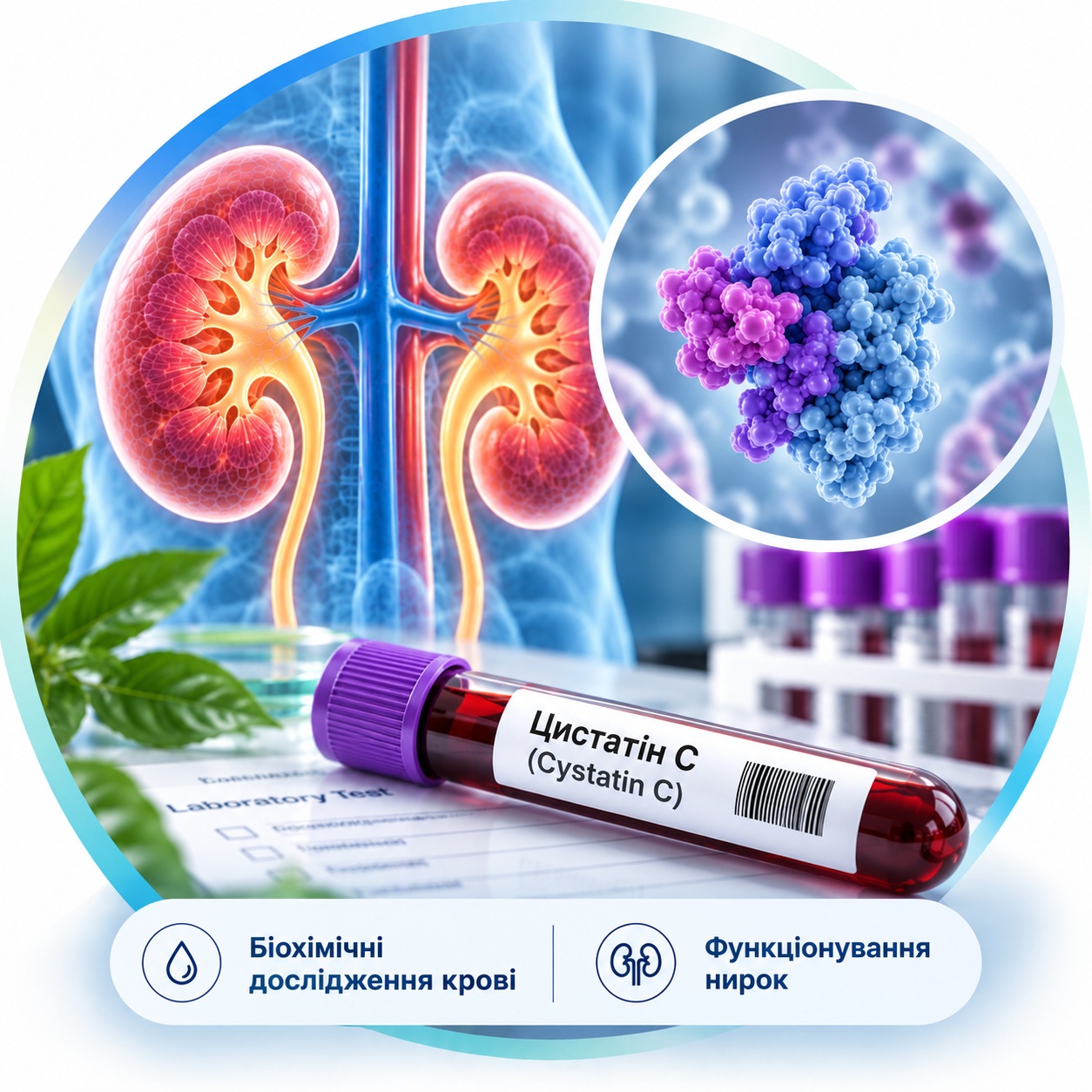
Cystatin C — a blood test to assess kidney function and kidney filtration capacity. The indicator helps to more accurately estimate the glomerular filtration rate (GFR), especially in situations where the creatinine level may not fully reflect kidney function. The result is evaluated together with other indicators and clinical data.
Cystatin C — a blood test to assess kidney function
Cystatin C — a laboratory blood test that helps assess kidney filtration function and calculate glomerular filtration rate (eGFR). Unlike creatinine, cystatin C levels are much less dependent on muscle mass, so its determination can be especially useful when assessing kidney function based on creatinine alone is not accurate enough.
What is cystatin C?
Cystatin C is a small protein that is constantly produced by the body's cells and enters the bloodstream. It passes freely through the kidney's filter, the glomeruli, and is then almost completely reabsorbed and metabolized in the renal tubules.
Therefore, the concentration of cystatin C in the blood may reflect changes in glomerular filtration. The lower the filtration capacity of the kidneys, the higher the concentration of cystatin C may be.
Why is the analysis prescribed?
The study may be recommended for:
- kidney function assessments;
- clarification of glomerular filtration rate;
- detection of a possible decrease in filtration function;
- clarification of the results obtained for creatinine levels;
- monitoring of kidney function in dynamics;
- comprehensive assessment for suspected chronic kidney disease;
- situations where creatinine levels may be less informative due to muscle mass characteristics.
Cystatin C and creatinine
Both creatinine and cystatin C can be used to assess kidney function. Each of these indicators has its own characteristics.
Creatinine is largely dependent on muscle mass, so its concentration may be less indicative in people with very low or high muscle mass.
Cystatin C is less dependent on this factor. Therefore, in certain clinical situations, determination of both indicators and calculation combined GFR by creatinine and cystatin C provides a more accurate estimate than using creatinine alone.
What numbers are estimated
Cystatin C itself is usually determined in mg/l, however, it is wrong to establish a universal "norm" for all laboratories. The reference interval depends on the research method and the specific test system, so you should focus primarily on the reference values indicated on the result form.
It is also important not to confuse 0.8 mg/l, which is used as a mathematical value in the CKD-EPI 2021 formula, with the universal upper limit of normal for cystatin C. This not a reference standard, and the parameter of the calculation formula.
A more practical indicator for assessing filtration is estimated GFR (eGFR).
The approximate categories of GFR in adults are as follows:
| GFR, ml/min/1.73 m² | Category |
|---|---|
| ≥90 | G1 - normal or high |
| 60–89 | G2 - slight decrease |
| 45–59 | G3a — mild/moderate decline |
| 30–44 | G3b - moderate/significant decrease |
| 15–29 | G4 - significant decrease |
| <15 | G5 - very pronounced decrease |
At the same time An eGFR of 60–89 mL/min/1.73 m² does not in itself indicate the presence of chronic kidney disease. The duration of changes and other signs of kidney damage are important for assessing chronic disease.
How is GFR calculated?
Formulas can be used for adults CKD-EPI, in particular:
- eGFR based on cystatin C;
- creatinine-based eGFR;
- combined eGFR based on creatinine and cystatin C.
The current CKD-EPI 2021 formulas do not use a race factor. If both creatinine and cystatin C are available, the combined calculation may provide a more accurate estimate of GFR.
Simultaneously eGFR is a calculated estimate, not a direct measurement of kidney filtration. Therefore, the doctor evaluates not only one obtained number, but also the dynamics of the indicator and other results.
What can elevated cystatin C mean?
Elevated cystatin C levels may be associated with decreased glomerular filtration rate. However, it is not possible to determine the cause of the change based on a single result.
For correct interpretation, the following can be taken into account:
- creatinine;
- cystatin C;
- estimated GFR;
- general urine analysis;
- albumin in urine;
- albumin/creatinine ratio in urine;
- blood pressure;
- results of previous studies;
- ultrasound data and other examinations as indicated.
Does high cystatin C always mean kidney problems?
Not necessarily. Cystatin C concentration can be affected by several factors not directly related to glomerular filtration rate. Therefore, the result should not be interpreted in isolation.
In doubtful cases, the doctor can compare the estimated GFR based on creatinine, cystatin C, and combined GFR.
If cystatin C is within the reference interval
A result within the reference interval is a favorable sign of kidney filtration function, but does not exclude all diseases of the urinary system.
For example, a urinalysis, urine albumin determination, or albumin/creatinine ratio may be needed for a more complete evaluation.
Preparation for analysis
For research, it is used venous blood.
Before taking the analysis, it is recommended:
- follow the laboratory's nutritional recommendations;
- avoid excessive physical exertion the day before;
- do not drink alcohol;
- Rest calmly before blood collection.
If you are taking medication, tell your doctor or laboratory staff. Do not stop prescribed medications on your own.
Importantly
Cystatin C is not an independent diagnosis. An increase or decrease in its concentration should be evaluated together with creatinine, estimated GFR, urinalysis, and other clinical data.
Observation can be particularly informative GFR dynamics, because one result does not always reflect the full picture of kidney function.
Medi Lab Plus conducts laboratory tests that help obtain additional information about the functional state of the kidneys and are used by the doctor for a comprehensive assessment of the results.
| Execution time | 1 day |
|---|---|
| Type of biomaterial | Venous blood |
Useful tests