

Antibodies to topoisomerase I (Scl-70), IgG
620 UAH
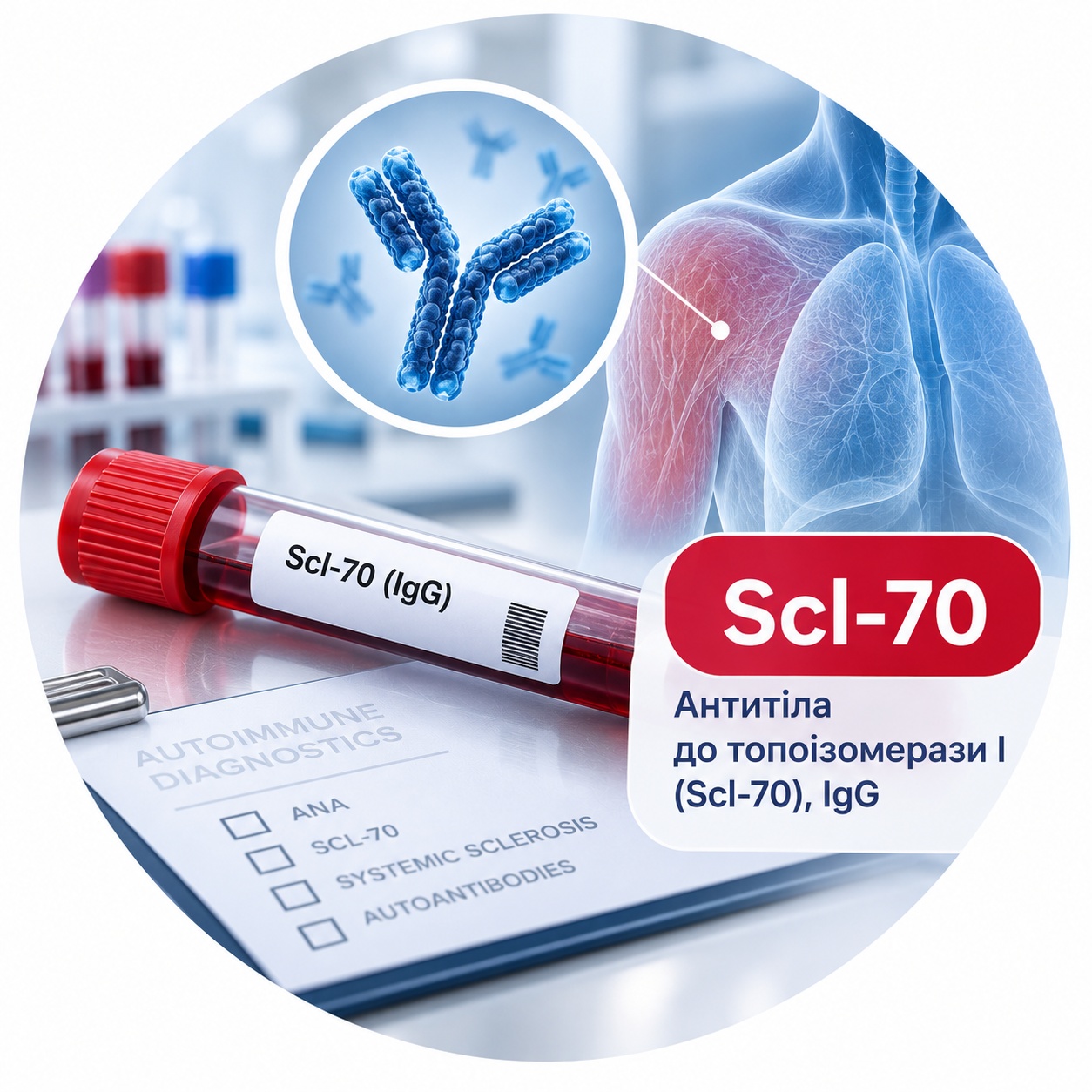
A highly specific immunological marker for the diagnosis of systemic sclerosis (systemic scleroderma), which allows the detection of IgG class autoantibodies to the DNA topoisomerase I enzyme.
Biomaterial: Venous blood
Research method: Enzyme-linked immunosorbent assay (ELISA) / Chemiluminescent immunoassay (CLIA)
Appointment: Diagnosis of systemic scleroderma (especially its diffuse form), assessment of the risk of damage to internal organs (in particular, pulmonary fibrosis), as well as differential diagnosis of systemic connective tissue diseases.
Topoisomerase I (Scl-70) antibody test, IgG — is a laboratory test aimed at detecting specific autoantibodies that the body produces against its own enzyme DNA topoisomerase I (molecular weight 100 kDa). During the fragmentation of this enzyme, an immunoreactive fragment with a mass of 70 kDa is formed, which gave rise to the historical name of the marker — Scl-70 (Scleroderma-70).
Scl-70 antibodies are considered one of the most important «diagnostic criteria» in rheumatology. They are detected in approximately 20–40% patients with systemic scleroderma and have high specificity (up to 95–100%) for this disease.
Clinical significance and interpretation of results
The test result is usually provided in a semi-quantitative or quantitative format (positivity index or IU/mL):
Negative result (< 1.0 or below the detection limit):
What does it mean: Antibodies to Scl-70 are not detected or their concentration is too low.
Clinical assessment: The probability of having diffuse systemic scleroderma is low. However, a negative result does not completely rule out the disease (especially its limited form, in which anticentromeric antibodies are more often detected) or other autoimmune pathologies.
Questionable result (within the gray area):
What does it mean: The antibody level is on the borderline between normal and pathological.
Clinical assessment: It is recommended to repeat the study in 2–4 weeks or perform an extended immunoblot for systemic connective tissue diseases.
Positive result (> 1.0 or above reference values):
What does it mean: An elevated level of IgG autoantibodies to topoisomerase I was detected.
Clinical assessment: High probability of systemic scleroderma (predominantly diffuse cutaneous form). The presence of these antibodies correlates with an increased risk of developing lesions of internal organs, in particular interstitial pulmonary fibrosis and peripheral vascular complications.
Indications for appointment
Presence of symptoms of systemic scleroderma: thickening, swelling or thickening of the skin of the fingers and hands (sclerodactyly), mask-like face, narrowing of the oral cavity, spider veins (telangiectasias).
Severe or progressive Raynaud's syndrome: Symmetrical pallor, blueness, and pain in the fingers/toes when exposed to cold or stress.
Examination for lung and heart damage: shortness of breath, dry cough, signs of interstitial pulmonary fibrosis or pulmonary hypertension of unknown etiology.
Differential diagnosis: Differentiation of systemic scleroderma from systemic lupus erythematosus (SLE), Sjögren's syndrome, mixed connective tissue disease (Sharp's syndrome) and dermatomyositis.
Preparation for the study
Delivery time: Blood sampling is performed in the morning on an empty stomach (after an 8–12-hour overnight fast).
Drinking regimen: You can drink pure, still water the day before and in the morning before the test.
Limitation: 24 hours before blood sampling, you should refrain from drinking alcohol, eating fatty foods, and excessive physical exertion. It is recommended not to smoke 1 hour before the procedure.
Frequently Asked Questions (FAQ)
1. Can Scl-70 antibody levels decrease during successful treatment?
No, the titer of antibodies to Scl-70 usually remains relatively stable throughout the course of the disease and correlates poorly with the dynamics or activity of symptoms. Therefore, this test is used mainly for primary diagnosis, and not for assessing the effectiveness of therapy.
2. If Scl-70 is negative, does this mean that scleroderma is definitely not present?
No. In limited form of systemic sclerosis (CREST syndrome), antibodies to Scl-70 are rarely detected (less than in 10% cases). In such situations, antibodies to centromeres (Centromere B) are of key diagnostic value.
Recommendations after receiving the results
With the results obtained, you should consult a rheumatologist.
A positive test result is evaluated exclusively in conjunction with the clinical picture, the results of nail bed capillaroscopy, and lung function tests (computed tomography, spirometry).
| Execution time | 1 day |
|---|---|
| Type of biomaterial | Venous blood |
Useful tests