
Calprotectin in stool and what an elevated result means

Calprotectin in feces is a kind of «alarm signal» for the doctor. This analysis allows you to detect whether there is an inflammatory process in the intestines. It is usually recommended to pass it if you have been bothered by diarrhea, pain or bloating for a long time, or if you have noticed impurities of mucus or blood in your stool. This test also helps the doctor figure out what we are dealing with: a functional disorder (for example, irritable bowel syndrome) or a serious inflammatory disease.
As MedlinePlus notes, the test measures the level of the protein calprotectin. If it is high, it is a sign of inflammation, but the result itself does not indicate a specific disease. Therefore, an elevated level is a reason for additional testing, not a final diagnosis.
It's important to understand: calprotectin doesn't specifically look for "Crohn's disease" or "colitis." It's just an indicator that there's a "fire" in the intestines. But why it happened — due to an infection, autoimmune disease, medication, or temporary irritation — is something the doctor can figure out with other tests.
What does calprotectin in feces show?
Calprotectin is linked to the activity of neutrophils, which are immune system cells involved in inflammation. When the lining of the intestine becomes inflamed, the amount of calprotectin in the stool can increase.
This is why the test is useful in situations where the symptoms may be similar but the causes are different. For example, abdominal pain, bloating and irregular bowel movements may be present in irritable bowel syndrome but can also occur in Crohn's disease or ulcerative colitis. NICE recommends faecal calprotectin as one option to support the differential diagnosis between inflammatory bowel disease and irritable bowel syndrome in adults with recent lower gastrointestinal symptoms when referral to a specialist is being considered and cancer is not suspected.
That is, calprotectin helps answer not the question «what is the diagnosis», but the question «does this look like inflammation that needs further examination?».
When a doctor may order this test
Analysis on calprotectin in feces It is most often prescribed when intestinal symptoms last more than a day and have no obvious explanation. It is especially useful when deciding whether further testing is needed.
Calprotectin may be recommended for the following complaints:
- prolonged or repeated diarrhea;
- abdominal pain;
- mucus in the stool;
- blood in the stool;
- frequent urge to go to the toilet;
- nocturnal bowel movements;
- bloating along with bowel movements;
- weight loss;
- anemia or weakness;
- suspected Crohn's disease;
- suspected ulcerative colitis;
- monitoring the activity of an already known inflammatory bowel disease.
The Mayo Clinic notes that when diagnosing inflammatory bowel disease, a stool test may be used to look for blood, infectious organisms, or inflammatory markers such as calprotectin.
What does elevated calprotectin mean?
Elevated calprotectin means that there may be inflammation in the intestines. But it is not a definitive diagnosis. The same result can have different meanings in different people.
Mayo Clinic Laboratories emphasizes that elevated fecal calprotectin is not diagnostic of inflammatory bowel disease, as other conditions, including celiac disease, colorectal cancer, and gastrointestinal infections, can also be associated with neutrophilic inflammation.
An elevated result may be associated with:
- Crohn's disease;
- ulcerative colitis;
- intestinal infection;
- inflammatory lesion of the mucosa;
- taking certain anti-inflammatory drugs;
- celiac disease;
- diverticular disease with inflammation;
- other organic intestinal diseases;
- Tumor processes that must be ruled out based on age and symptoms.
Therefore, after a high result, it is important not to treat "calprotectin", but to find the cause of its increase.
How to roughly interpret the result
The norms and limits may vary depending on the laboratory, the method of examination, the patient's age and the clinical situation. Therefore, the result should be evaluated against the references of the specific laboratory and together with the doctor.
| Result option | What could this mean? | What do they usually do next? |
|---|---|---|
| Low or within normal limits | Active intestinal inflammation is less likely | The doctor looks for other causes of the symptoms or observes the dynamics |
| Borderline result | Possible mild inflammation, effects of medications, infection, or temporary condition | Re-testing or additional testing may be required. |
| Moderately elevated result | There is reason to think about inflammation of the intestinal mucosa | The doctor evaluates symptoms, blood and stool tests, and the need for referral to a gastroenterologist |
| Significantly increased result | More reasons to suspect active organic inflammation | Often requires in-depth examination, including endoscopy if indicated |
| Elevation in a patient with known IBD | May indicate disease activity or risk of exacerbation | The doctor assesses the dynamics, treatment and the need for additional monitoring |
It is important not to compare your result with someone else's. For one person, a borderline increase may be temporary after an infection, while for another it may be an important signal in the case of an already established inflammatory bowel disease.
Calprotectin and Crohn's disease
In Crohn's disease, inflammation can affect different parts of the digestive tract. Calprotectin helps to see if there are signs of active intestinal inflammation, but it does not show on its own where it is located or how deep the intestinal wall is affected.
In the article about Crohn's disease It explains in more detail why a diagnosis usually requires not just one laboratory number, but a combination of blood tests, stool tests, endoscopy, biopsy, and instrumental methods.
The Crohn's and Colitis Foundation describes fecal calprotectin as a stool test for intestinal inflammation that helps predict active inflammatory bowel disease.
Calprotectin and irritable bowel syndrome
Irritable bowel syndrome can cause pain, bloating, diarrhea, or constipation. But it is a functional disorder, in which there is usually no inflammatory damage to the intestinal mucosa. This is why calprotectin can be useful when the symptoms are similar, but it is necessary to understand whether there is reason to look for an inflammatory disease.
NICE considers faecal calprotectin to be a test that helps distinguish inflammatory bowel disease from non-inflammatory conditions such as irritable bowel syndrome.
If calprotectin is normal, this may reduce the likelihood of active inflammation. However, if there is blood in the stool, anemia, weight loss, nocturnal symptoms, or age and risk factors are a cause for concern, the doctor should not limit himself to this test.
Why the increase may not be due to IBD
Elevated calprotectin does not always mean Crohn's disease or ulcerative colitis. It responds to inflammation, and inflammation can have different origins.
Common alternative causes include:
- bacterial or viral intestinal infection;
- parasitic infections under certain conditions;
- taking nonsteroidal anti-inflammatory drugs;
- recent acute intestinal disease;
- celiac disease;
- diverticulitis;
- other inflammatory processes;
- Colorectal tumors that need to be excluded according to indications.
If symptoms are acute in onset, include fever, nausea, vomiting, watery diarrhea, or are associated with a suspicious food, the doctor may initially consider an infectious cause. In such a situation, it may be appropriate to stool analysis for pathogens, so as not to confuse an infectious process with a chronic inflammatory disease.
What tests may be needed after an elevated result?
The next step depends on your calprotectin level, symptoms, age, duration of symptoms, family history, medications, and other test results. Sometimes your doctor will order a repeat test. In other cases, you may need to see a gastroenterologist right away.
After an elevated calprotectin, you may need:
- complete blood count;
- C-reactive protein;
- ESR;
- ferritin and iron metabolism indicators;
- biochemical blood test;
- stool test for occult blood;
- stool examination for infections;
- celiac disease tests as indicated;
- colonoscopy;
- biopsy during endoscopy;
- Ultrasound, MRI or CT enterography at the doctor's discretion.
The Mayo Clinic notes that blood tests, stool tests, colonoscopy, computed tomography, magnetic resonance imaging, capsule endoscopy, and other methods may be used to diagnose Crohn's disease, depending on the clinical situation.
When the result needs to be discussed faster
There are symptoms that you shouldn't monitor at home for a long time or wait for everything to go away on its own. Even if calprotectin has not yet been tested or the result is only moderately elevated, a combination of alarming signs requires medical evaluation.
See a doctor quickly if you have:
- blood in the stool;
- black stools;
- prolonged diarrhea;
- nighttime urges to go to the toilet;
- severe or increasing abdominal pain;
- high temperature;
- severe weakness;
- dehydration;
- weight loss for no apparent reason;
- anemia;
- vomiting;
- family history of inflammatory bowel disease or colorectal cancer.
It is especially important not to interpret high calprotectin as «just irritable bowel syndrome» if there is blood, anemia, weight loss, or nocturnal symptoms. Such signs require further diagnosis.
How to properly take a stool test for calprotectin
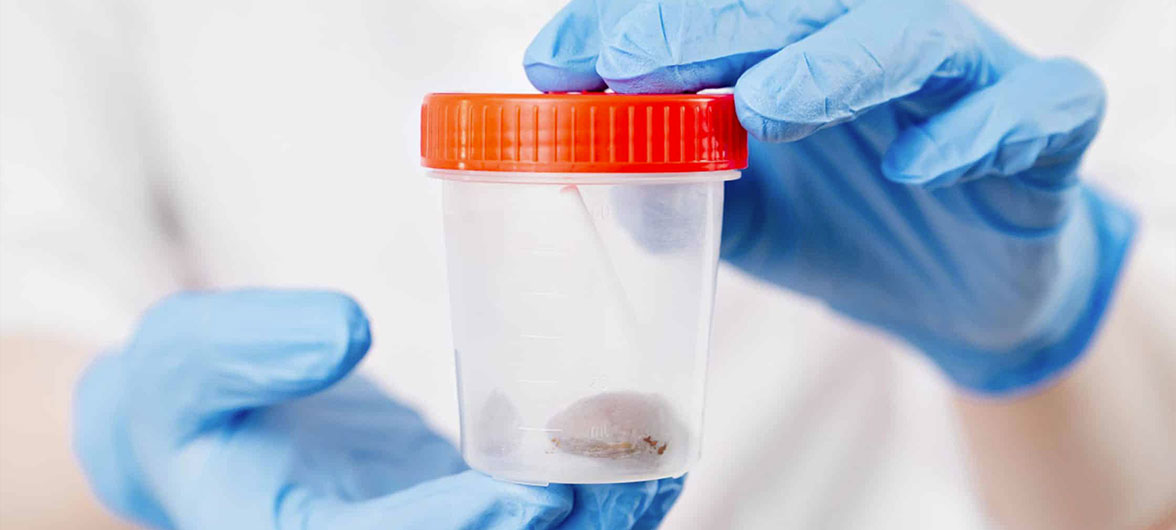
The quality of the result depends not only on the laboratory method, but also on the correct collection of the sample. Usually a small stool sample in a clean sterile container is required. It is important to avoid impurities of urine, toilet water or household dirt.
Before submitting, it is worth clarifying with the laboratory:
- what container is needed;
- how much material to collect;
- how to deliver the sample quickly;
- Can the material be stored in the refrigerator?;
- do medications affect the result;
- whether it is necessary to postpone the test after an acute infection;
- Do I need to report taking nonsteroidal anti-inflammatory drugs?.
Mayo Clinic Laboratories notes that due to the uneven distribution of calprotectin in fecal material, results may vary with repeated monitoring, especially in samples with high calprotectin concentrations.
What can affect the result?
Calprotectin levels can be affected by more than just chronic inflammatory diseases, so it is important to consider the circumstances before interpreting.
The result may be higher or more difficult to assess if:
- recently had an intestinal infection;
- there is acute diarrhea;
- the person is taking nonsteroidal anti-inflammatory drugs;
- there is blood in the stool;
- have another inflammatory bowel disease;
- the sample was collected incorrectly;
- analysis is used for dynamic control;
- little time passed between the two tests;
- symptoms changed after treatment.
That is why the doctor may ask to repeat the analysis after a certain time or to undergo additional tests if the result does not correspond to the clinical picture.
Is it possible to lower calprotectin on your own?
Calprotectin is not an indicator that needs to be «lowered» by itself. If it is elevated, the main task is to understand the cause of the inflammation. Self-administration of antibiotics, anti-inflammatory drugs, sorbents or strict diets may not solve the problem and sometimes complicate the diagnosis.
You should not do it yourself:
- starting antibiotics without a prescription;
- take hormonal or immune drugs;
- attribute a high result solely to stress;
- postpone colonoscopy if the doctor sees indications;
- repeat the analysis many times without a plan;
- treat the result without a diagnosis;
- ignore blood in the stool or weight loss.
If calprotectin is elevated, the best solution is to discuss the result with a doctor who will take into account symptoms, history, other tests, and the need for instrumental diagnostics.
FAQ
Does elevated calprotectin mean Crohn's disease?
Not always. Elevated calprotectin shows signs of intestinal inflammation but does not establish a specific diagnosis. The cause may be Crohn's disease, ulcerative colitis, infection, celiac disease, certain medications, or other conditions.
Can calprotectin be high with intestinal infection?
Yes, it can. If the intestinal mucosa is inflamed due to an infection, calprotectin can increase. That is why, in case of acute diarrhea or fever, the doctor may prescribe stool tests for pathogens.
Is a colonoscopy necessary after high calprotectin?
This is not always, but often, considered by a gastroenterologist. If the result is significantly elevated, symptoms persist, or there is blood, anemia, weight loss, or nocturnal diarrhea, a colonoscopy may be necessary to clarify the cause.
Can a normal calprotectin completely rule out inflammatory bowel disease?
A normal result reduces the likelihood of active intestinal inflammation, but does not always completely rule out the disease. The decision depends on symptoms, blood tests, age, duration of complaints and the presence of alarming signs.
Is it necessary to repeat calprotectin?
Sometimes yes. Repeat testing may be needed for borderline results, after infection, to monitor the activity of a known inflammatory bowel disease, or to assess progress after treatment.
Can I get calprotectin without a doctor's prescription?
Technically, it's possible, but it's best to interpret the result with your doctor. Without taking into account symptoms, medications, other tests, and risk factors, a high or borderline result may cause more anxiety than good.
Calprotectin in stool helps to detect inflammation in the intestine, but is not an independent diagnostic criterion. An increase in the level can be a signal of Crohn's disease, ulcerative colitis or infection, but it is always interpreted comprehensively - together with clinical symptoms, blood tests, microbiological examination of feces and, if necessary, endoscopy. This makes it possible not to miss serious pathology and avoid erroneous conclusions based solely on the level of this marker.

Director of Medi Lab Plus LLC, a doctor of the highest category. Has over 45 years of practical experience in medicine and laboratory diagnostics. Founder and head of the laboratory since 2007. More details…

